
Panel Discussion

Comments on the Jurors’ Special Prizes Winners (seven works)(6/7)
NATSUME(MC) ───── Next, the Shinya YAMAMURA Prize:Montage by Gakuto SASAKI. I would like to call upon Professor Shinya YAMAMURA for his comments.
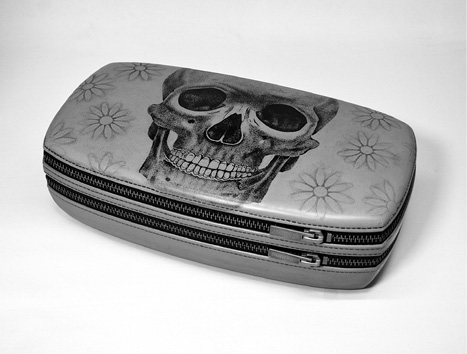
Shinya Yamamura Prize
Montage
W33 × D18.4 × H10.3
SASAKI Gakuto(Japan)
Shinya YAMAMURA ───── I will provide the critique for Gakuto SASAKI’sMontage. This is a work that demonstrates, through superior technique and modern sensibility, that lacquer possesses a diversity of expression beyond our imagination. Mr SASAKI is active in many areas, so many of you likely know him, and this work, too, appears at first glance to be a leather case with a zipper. However, as one gets closer, one realizes that almost everything, including the parts that look like leather or metal, is created from lacquer. The moment one understands what it is made of, there is a sense of surprise, and perhaps a slight unease about what one has been looking at. I believe the appeal of this work lies in that sensory fluctuation.
Lacquer is not merely a paint for finishing surfaces beautifully. Through coating, whetting, polishing, and adding various materials, it can transform into different textures such as leather, metal, cloth, or stone. This is a technique that has been refined within Japanese lacquer culture for a long time, such as the kawari-nuri (alternative coating) and saya-nuri (scabbard coating) seen on sword sheaths. Mr SASAKI fully understood this tradition and expanded it into a familiar, modern everyday item – leather and a zipper. The importance lies in the fact that he is not simply recreating old techniques but using contemporary forms to change the way we look at lacquer itself.
Lacquer is truly difficult material to handle. It is at the mercy of temperature and humidity, does not always go as planned, and requires a great deal of time. If one thinks only of efficiency, it is a material unsuited to the modern age. However, on the surface of this work, the time spent facing this uncooperative material and the tactile sensations of the hand remain. In an era where AI and digital technology can already create images that look like leather or metal, the weight and touch of the actual object, and even the slight sense of ‘wrongness’ felt only upon approaching it, cannot be conveyed through a screen. This work makes us rediscover the depth of lacquer through that physical experience.
I rated this work highly for elevating traditional techniques into a new expression that is possible only because of lacquer, by linking technical display with modern design. That is all.
NATSUME(MC) ───── Thank you, Professor Shinya YAMAMURA.