
Panel Discussion

Gold Prize Winners (two works)(2/2)
NATSUME(MC) ───── Next, the Gold Prize in the Design category:RAYS PLATE Ai-Urushi by Hiroyuki MORI. Professor Shinya YAMAMURA, may we have your comments on this piece?
Shinya YAMAMURA ───── I will provide the critique for this year’s Gold Prize in the Design category. I was not previously acquainted with Mr MORI, but I understand he is a director of MORI KOGEI, a company in Tokushima, Shikoku. My first impression was of a work that beautifully presents new possibilities for lacquer within modern living. What catches the eye is this Ai-urushi (Indigo Lacquer). You may not have heard the term, but it is a deep, quiet hue that cannot be strictly defined as either blue or black. Lacquer possesses a beautiful luster and a durable film and has long supported Japanese lifestyle. Indigo, specifically Awa Indigo, is also more than a mere dye; it is a culture nurtured by the climate and the lives of the people in Tokushima. I believe the great charm of this work lies in the fusion of these two elements.
Indigo and lacquer are not simple materials that become beautiful the moment they are mixed. There were surely various technical challenges regarding pigmentation and the stability of the film. I do not know whether the indigo was mixed into the lacquer initially or used as a dye with lacquer applied over it, but I understand that in order to make this a reality, technical cooperation was sought from the Tsutsumi Asakichi Urushi Store Co., Ltd. in Kyoto. Through their long experience and extensive trial and error, they achieved this profound color.
Furthermore, a characteristic of MORI KOGEI is the technique they call Kosen-bari (sunburst veneering), where sliced wood is applied to the surface to create a pattern. This sunburst pattern creates a grain that radiates outwards; from a distance, it appears very still, but as one changes the viewing angle, it catches the light to reveal delicate expressions. It is a fusion of the accidental patterns of nature and the human hand that brings them to life. There is a beauty there that is incredibly uniform yet possesses depth and warmth that digital technology cannot replicate. As you can see, the form is extremely simple. However, it is precisely this simplicity that draws out the color of the indigo lacquer and the wood grain.
The plate does not assert itself too strongly; it is a beautiful piece that allows one to naturally imagine the scenery when food is served, while also being well-considered as a tool for daily life. Material attraction, the technique to realize it, and the design that connects it to living – these three have become one, opening up tradition to the modern dining table. With high regard for its refinement and future potential, it was the unanimous decision of the jury to award this the Gold Prize in the Design category.
NATSUME(MC) ───── Thank you, Professor Shinya YAMAMURA.
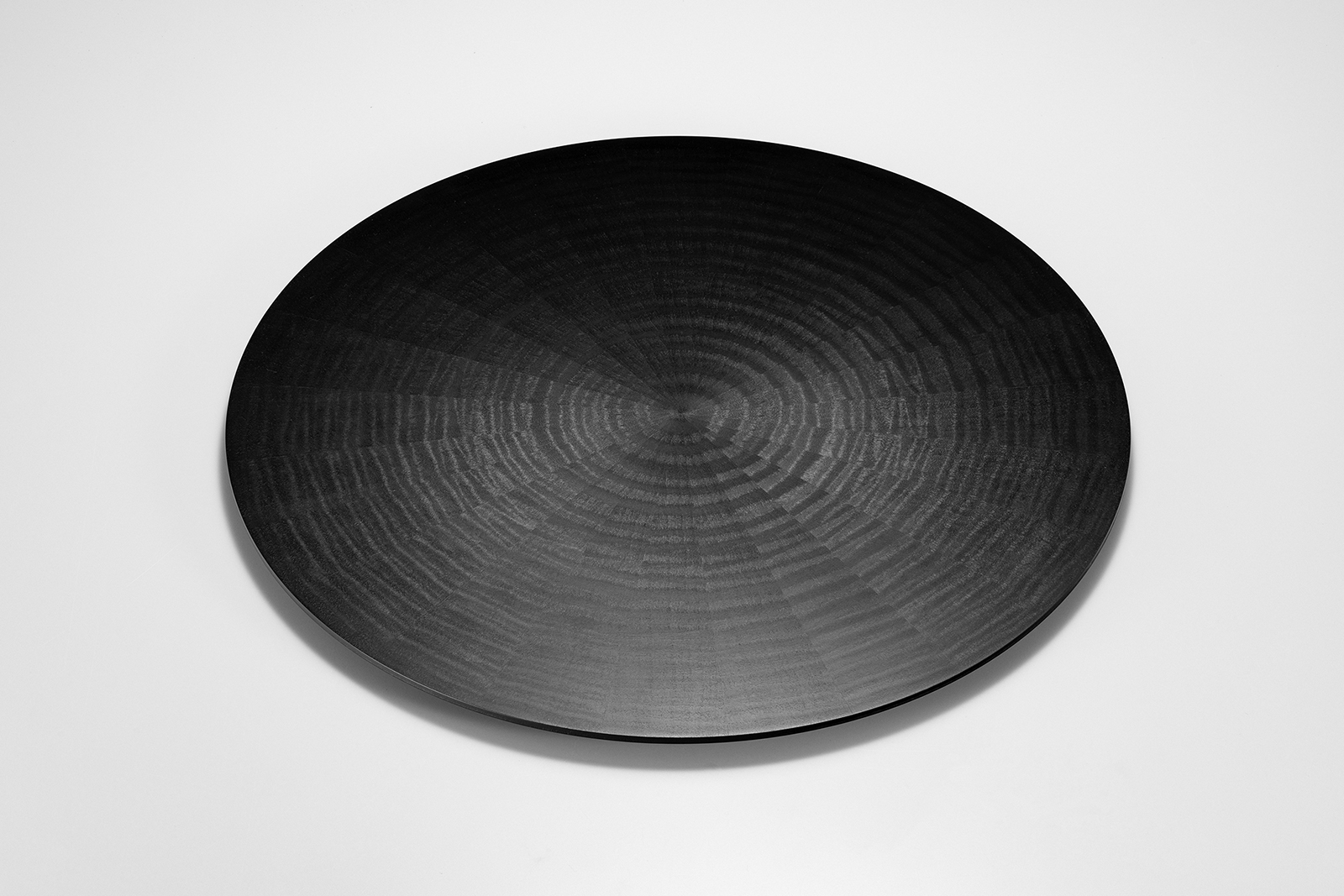
Gold Prize
RAYS PLATE Ai-Urushi
W36 × D36 × H1.2
MORI Hiroyuki (Japan)